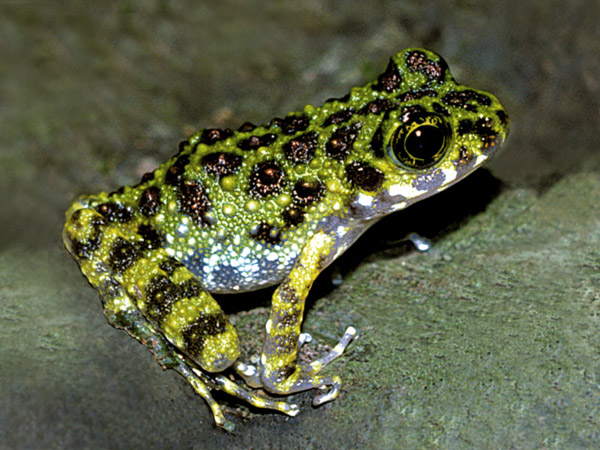
Ishikawa's Frog


True Wild Life | Ishikawa's Frog | Ishikawa's Frog is the most beautiful frog in Japan. Forests are disappearing and rivers are becoming dirty. Ishikawa's frog is in danger. Amphibians have trouble changing when their environment changes. They have a purple and green pattern that looks like moss. It hides them from their enemies.
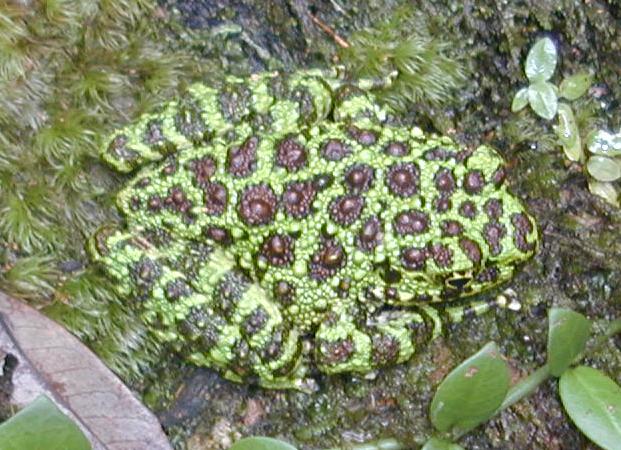

The population of Okinawajima is designated as a natural monument by Okinawa and Kagoshima Prefectures, but there remains a need for improved protection of forest habitat on both Okinawajima and Amamioshima.


Ishikawa's Frog only lives on Okinawa's main island, and is a very special frog. Some people believe they are Japan's most beautiful frog. Ishikawa's Frog needs small mountain streams in forests to live. However, forests are disappearing and rivers are becoming dirty. Ishikawa's Frog cannot live safely. Their numbers are becoming smaller, and we worry about their disappearance in the future. To stop the disappearance of Ishikawa's Frog, severe rules about catching and caring for them were made. But, that's not enough to save Ishikawa's Frog. Frogs are amphibians, and are very sensitive to changes in environment. We must give back the rivers, forests, and the surrounding nature to Ishikawa's Frog.

Goliath Frog


True Wild Life | Goliath Frog | The Goliath Frog is the biggest frog in the world. They have been popular as food from a long time ago. They are also caught to keep as pets or for their skin, and their numbers have gone down to half of what they were before. This animal has a relatively small habitat range, mainly in Cameroon and Equatorial Guinea. Its numbers are dwindling due to habitat destruction, its collection for consumption as food and its collection for the pet trade.


The goliath frog is normally found in and near fast-flowing rivers with sandy bottoms in the West African countries of Cameroon and Equatorial Guinea. These rivers are usually clear and highly oxygenated. Their actual range spans from the last 200 km of the Sanaga basin in Cameroon to the north to the last 50 km  of the Benito River basin in Equatorial Guinea to the south. The river systems in which these frogs live are often found in dense, extremely humid areas with relatively high temperatures. The goliath frog can live up to 15 years in the wild. In captivity, they can live up to 21 years. While male Goliath frogs weigh up to 8 pounds, females can weigh up to 7. These frogs have acute hearing but no vocal sac, and additionally lack nuptial pads.


The goliath frog, like most frogs, feed on worms, and insects, such as dragonflies and locusts. Bees and wasps could be prey, but since they have stingers they use as a weapon, the goliath frog rarely even catch one. Goliath Frogs also eat smaller frogs, largely crabs, baby turtles, and young snakes. The goliath frog is also preyed on by snakes, Nile crocodiles and Nile monitors.


Like all amphibians the water is vital for their reproduction. The males will construct spawning and breeding areas alongside and within rivers by pushing rocks into semicircular patterns. Not much is known about the goliath frog's reproduction; however, some African scholars have started to do more research for medical reasons. They are the biggest frogs in the world. As tadpoles they are pretty small, and become frogs about 1.4cm in length. Once they become frogs they get bigger little by little.

The increase of people in the Goliath Frog's living space has become a problem. First, the spaces where they can live have become fewer. Also, Goliath Frogs are skilled swimmers and live near rivers. Because of people, the rivers have started to get dirtier, and the frogs are no longer able to live in a safe environment like before.

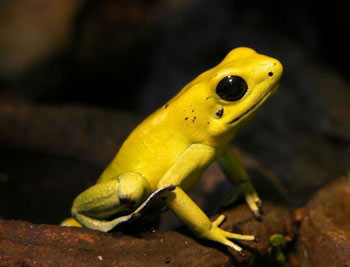
Golden Poison Frog


True Wild Life | Golden Poison Frog | The Golden Poison Frog is the most poisonous animal in the world. Unfortunately, they are on the brink of extinction because tropical rainforests are disappearing. The golden poison Frog's skin is densely coated in alkaloid poison, one of a number of poisons common to dart frogs  which prevents nerves from transmitting impulses, leaving the muscles in an inactive state of contraction. This can lead to heart failure or fibrillation.


The Golden Poison Frog's natural enemy is a genus of snakes called the Leimadophis Epinephelus. These snakes are unaffected by the lethal poison of the Golden Poison Frog. The Golden Frog lives on the ground in humid forests, and is only known from primary forest. It is not known whether or not it can adapt to secondary habitats. The eggs are laid on the ground and the males transport the larvae to permanent pools.  The main natural sources of food of Golden Poison Frogs are the ants in the genera Brachymyrmex and Paratrechina, but many kinds of insects and other small invertebrates can be devoured, specifically termites and beetles, which can easily be found on the rainforest floor. This frog is considered the most voracious of the dendrobatids.


In captivity, the frog is fed with Drosophila fruit flies, cochineals and crickets, the larvae of various insects, and other small live invertebrate foods. An adult frog can eat food items much larger in relation to its size than most other dendrobatids. Golden Poison Frog is a very important frog to the local indigenous cultures, such as the Choco Emberá people in Colombia's rainforest. The frog is the main source of the poison in the darts used by the natives to hunt their food. The Emberá people carefully expose the frog to the heat of a fire, and the frog exudes small amounts of poisonous fluid. The tips of arrows and darts are soaked in the fluid, and keep their deadly effect for over two years.


In many ways, humans have benefited from the Golden Poison Frog. Yet today, the wild frogs are in danger of extinction. They live in only certain parts of tropical rainforests that are disappearing as deforestation and farm land development continues in various parts of the world.